market_report Geopolitical riskMarkets & trade Splash247
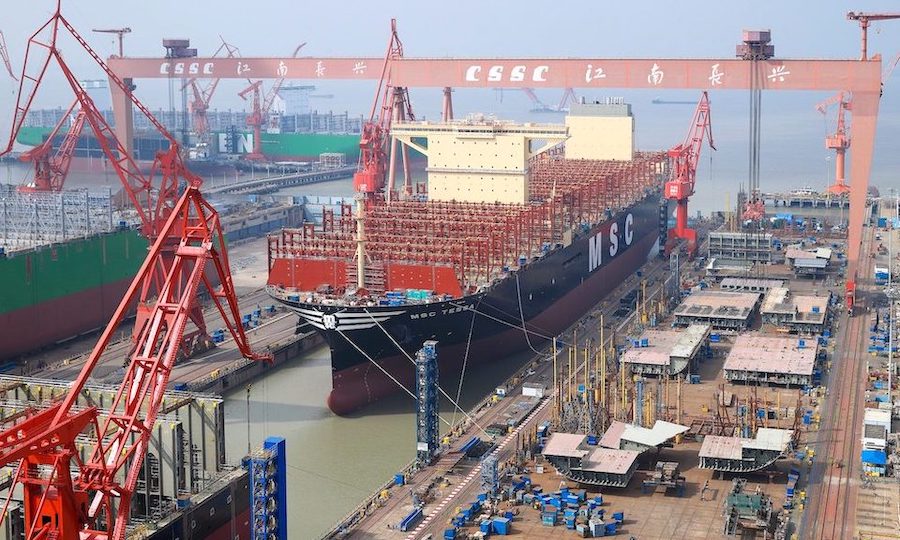
Deglobalisation is now a fact. The World Trade Organization is a defunct institution. The US threatens global tariffs and follows a policy of replacing income tax with import tax, believing that suppliers to the US will pay it, not US importers. Other countries and groups will respond. Global supply chains are fracturing and splintering into parallel regional supply chains, adding inefficiency and cost. The Paris Accord, which obliges signatory states to enshrine in law efforts to cap global average temperature rises to 1.5C above a 1990 baseline, is a dead letter. The International Maritime Organization, after another week of negotiations, faces intense diplomatic efforts if it is to reach agreement on a carbon levy or to keep its net-zero-by-2050 ambition alive at all. The latest report from the University College London climate boffins says that every ship built from now on must operate on “clean” fuels (which do not yet exist in sufficient quantities) and that every ship built since 2016 will either have to be retrofitted for clean fuels or scrapped. Some liner companies are pushing back against biofuels which look great as they can be dropped in to current fuel supply chains and existing marine engines, but will require vast quantities of farmland to be given over to growing crops for fuel not food. The global container fleet has grown by a quarter in five years In these circumstances, what decisions should environmentally conscious but profit-driven liner company executives make on fleet renewal? Perhaps the biggest 24,000 teu ships will be in less demand in a globalised world of regional supply chains. Perhaps environmental agreements will be forgotten and everyone can go back to burning fuel oil. If you are MSC’s board, you decide to spend up to $1.75bn on four option four LNG dual-fuel 21,700 teu container ships at Zhoushan Changhong International shipyard in China. This is MSC’s third contract with the yard since 2022, bringing its spending at just that yard to a possible $6.75bn. Similarly, if you are George Economou’s company TMS group, you go to the same yard for 10 LNG dual fuel 18,000 teu vessels for around $1.4bn. And, if you are CMA CGM you order a dozen LNG dual fuel, 18,000 teu ships at Jiangnan Shipyard in China for a total of $2.5bn. Even Germany’s Peter Dohle Schiffahrts has ordered containerships for the first time in 10 years, taking four 14,000 teu ships at Hudong-Zhonghua and five 8,400 teu ships at Guangzhou Shipyard International. If you are the Indian government, you announce a decision to break the stranglehold that liner companies have over Indian containerised imports and exports by creating a state-owned liner company which will own 100 ships, mostly procured from the existing fleet. The policy seems guaranteed to keep prices and time charter rates for containerships at or near recent all-time heights. The global fully cellular container ship fleet is now 30.65m teu while the orderbook has breached the 9m teu level. Deliveries this year so far total around 300,000 teu. This ongoing newbuilding spree looks as sensible as a mad hatter’s tea party, but the liner companies can point to the trend in freight rates during the 2020s: earnings per teu have far surpassed expectations even as the fleet has grown by a quarter in five years. After all, in spite of the noises from Washington DC, the two main US west coast ports of Los Angeles and Long Beach reported handling nearly 2m teu in January, a record for the
Containers: Mad as a Hatter?
Splash247
Read full article at Splash247 →
Opens Splash247 in a new tab


