news ContainerCruise Decarbonization & energy Manifold Times
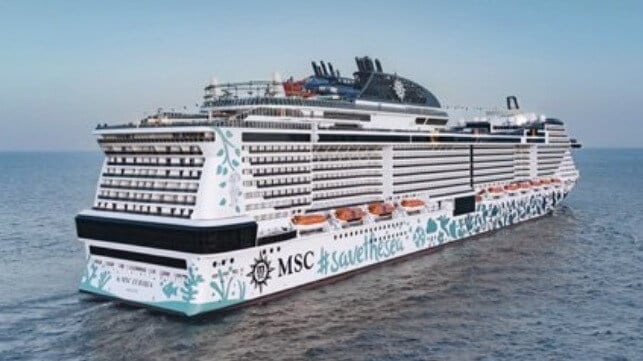
MSC Group’s Cruise Division used 9,839 metric tonnes (mt) of renewable fuels in 2025 across its fleet, according to its 2025 Sustainability Report published last week. The company used a combination of bio-LNG and biofuels across its fleet, resulting in emissions reduction of 48,714 mtCO2e compared to equivalent fossil fuels. Based on the Energy Transition Plan, the report showed that MSC Cruises and Explora Journeys remain on track to achieve net-zero greenhouse gas (GHG) emissions for marine operations by 2050. In 2025, MSC Group’s Cruise Division achieved the International Maritime Organization’s (IMO) 2030 carbon intensity reduction target five years ahead of schedule. The report said the MSC Cruises demonstrated a net-zero voyage using biomethane was possible with the launch of MSC Euribia in 2023. Since then it has actively engaged with fuel producers and suppliers to secure affordable high quality renewable fuels and in 2026, it began blending them into its operations at scale. The bio-LNG it sourced in 2025 was produced from a variety of different sustainable feedstocks, including food waste, sewage sludge, organic municipal waste and, most notably, manure. As most of its fleet remains conventionally powered, biodiesel represents the only drop-in solution available for these vessels today. In 2025, MSC Europa ran on a total of 6,856 mt of bio-LNG while MSC Opera used 1,727 mt of hydrotreated vegetable oil (HVO). MSC Seaview sailed using 572 mt of HVO and 684 mt of a B24-VLSFO blend. Photo credit: MSC Cruises Published: 3 June, 2026
Report: MSC Cruises ships operated on over 9,800 mt of bio-LNG and biofuels in 2025
Manifold Times
Read full article at Manifold Times →
Opens Manifold Times in a new tab