casualty_report TankerDry bulk Safety & casualtyOperational risk Marine Insight
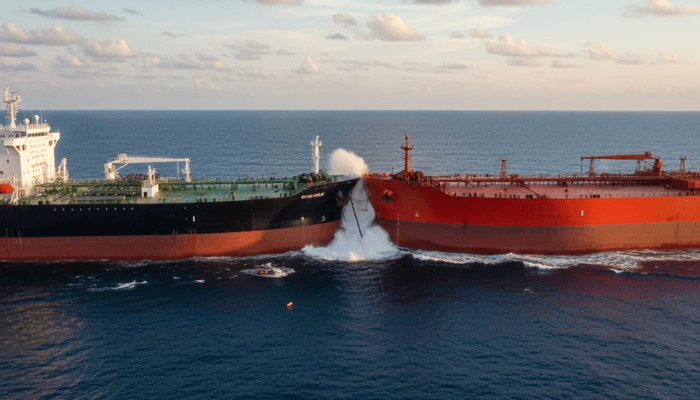
A loaded VLCC was making way eastbound in good visibility in the deepwater route of a busy traffic separation scheme (TSS) (VLCC track shown in yellow on illustration below). The vessel entered the TSS at 2035 hours with the Master, OOW and helmsman on bridge and two lookouts forward. A few minutes later, a westbound capesize bulker was noticed on the VLCC’s radar entering the eastbound lane (bulker’s track shown in red below). Vessel Traffic Services (VTS) made several calls to the bulker warning that there was a deep laden VLCC tanker in the eastbound lane and they needed to give it a wide berth. Although the bulker acknowledged the warning, there was no change of course. Soon after, the VLCC also called the bulker but received no reply. The VTS intervened and responded that the bulker would keep clear of the VLCC. Credits: nautisnt.org At 2046 the VTS again called the bulker to check if she was altering course. The OOW on the bulker responded confusingly, asking what the intention of the VLCC was and where she was bound. VTS reiterated that the VLCC was eastbound in the deep water lane, and to keep well clear of the vessel. At 2048, when the vessels were about six cables apart, the bulker made a sudden bold alteration to port, bringing it in direct conflict with the VLCC. The bridge team on the VLCC altered to starboard to bring their vessel parallel to the bulker and reduce the impact. One minute later the bow of the VLCC made contact with bulker’s starboard side in way of the forward cargo holds. Two crew members on the VLCC who were keeping lookout on the bow received serious injury to their legs. The company investigation on the part of the VLCC did not have access to the other side of the story, but nonetheless the following was posited: It would appear that poor judgment and less than adequate communications, as well as an almost total lack of situational awareness on the part of the bulker’s OOW led to this collision. Neither vessel used engines to reduce speed. Lessons learned In less than 10 minutes, the situation went from commonplace to critical. This is a good example of why active and attentive navigation is always necessary, especially in a busy TSS. Using all available means to attract the attention of the other vessel’s bridge team (sound and light signal) to give warning of the situation may have helped. When confronted with an imminent collision, lookouts on the bow should clear the area. Reference: nautinst.org Disclaimer : The information on this website is for general purposes only. While efforts are made to ensure accuracy, we make no warranties of any kind regarding completeness, reliability, or suitability. Any reliance you place on such information is at your own risk. We are not liable for any loss or damage arising from the use of this website. Related Posts Real Life Incident: Collision Of Container Ship and General Cargo Ship Leads To Sinking And Fatalities Real Life Incident: Collision and Sinking of Small Craft in Shipping Lane Real Life Incident: Crew Saved but Ship Lost Real Life Incident: Pin Holes Create Pathway To Fatal Reckoning Related Posts Real Life Incident: Collision Of Container Ship and General Cargo Ship Leads To Sinking And Fatalities Real Life Incident: Collision and Sinking of Small Craft in Shipping Lane Real Life Incident: Crew Saved but Ship Lost Disclaimer : The information on this website is for general purposes only. While efforts are made to ensure accuracy, we make no warranties
Real Life Incident: VLCC Makes Contact With Bulker

Marine Insight
Read full article at Marine Insight →
Opens Marine Insight in a new tab