market_report Markets & trade Splash247
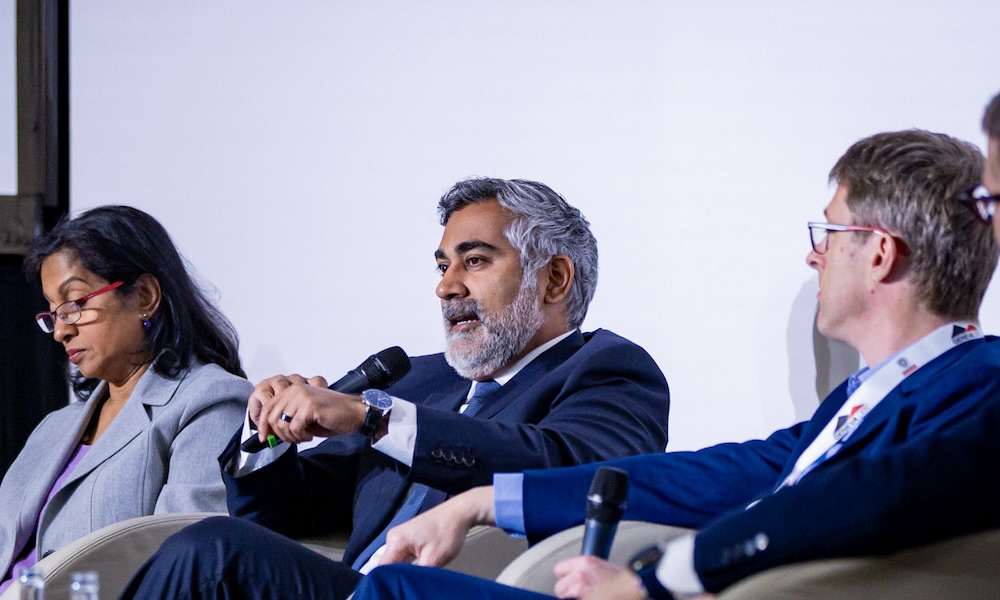
As metaphors go to highlight today’s tortuous trading environment, the fact that the Economic and Commodities Outlook session kicked off Friday’s Geneva Dry conference with an empty seat on stage was rather apt – Shamika Sirimanne, director of the UN Trade and Development’s division on technology and logistics, was snarled up in traffic just outside the World Trade Organization building of all places. She was able to take her seat alongside moderator Sam Chambers, the editor of Splash, 10 minutes into the debate which had been billed as a scene-setter for much of the other sessions that were to follow that day. Click to enlarge Saad Rahim, chief economist at Trafigura, was asked to get proceedings underway, giving his take on where the global economy was headed for the next 48 months. “The US economy is not just firing on all cylinders, it’s finding new cylinders to fire on,” Rahim told delegates, going on to highlight other areas where “pockets of growth” have materialised recently. Click to enlarge Rahim argued that too many headlines had focused too strongly on China’s troubled property sector and that commodity import data showed there was more to the health of the People’s Republic than apartment sales. He pointed out China recorded record copper, aluminium, oil and gas demand last year. “That’s not an economy that is suffering in the way that I think the headlines and sentiment suggest,” Rahim said, going on to point out that infrastructure spending and manufacturing remain “very, very strong”. Click to enlarge Likewise, Rahim said the Indian economy was showing strong growth, while in Europe some “green shoots” were emerging. “So long story short, I think we’re looking at a global economy that is actually quite healthy and that is starting to pick up steam, but we need a little bit more push from China to to really get going. And if the Fed does decide to cut at any point this year, I think that just sort of turbocharges everything as well,” Rahim concluded. Taking her seat on stage, Sirimanne from the United Nations, was immediately pressed into action with her views sought on the global economy. “Global trade is resilient. It’s steady, but slow,” she said, forecasting the world merchandise trade volume with increase somewhere between 2.5% and 2.6% this year, picking up to 3.3% in 2025, figures that are very much on trend with the past 20 years with the exception of the downturn experienced during covid. Turning to seaborne trades, the UN body is forecasting maritime trade will grow around 2.1% over the 2024-2025 period, below the average 2.8% 20-year trend. Discussion then turned to some of the variables the dry bulk shipping community is faced with in 2024 such as diversions from the Red Sea and the Panama Canal. The Red Sea diversions add “a bit of spice” in a market that’s already “quite fundamentally tight”, said Dr Roar Adland, global head of research at broking house SSY. Overall, the issues in Panama and off Yemen have added 1.4% to overall ton-mile demand, according to SSY estimates. “Each time we have infrastructural inefficiencies in the supply chains it is good for shipping, including dry bulk,” said Christopher Rex, head of sustainability and research at Danish Ship Finance, a bank. Rex admitted that the growth in iron ore and coal shipments experienced recently had caught many by surprise. Rex voiced concern about the potential “toxic cocktail” brewing from the immense debts from the Chinese real estate sector, urg
The economic and commodities outlook from Geneva
Splash247
Read full article at Splash247 →
Opens Splash247 in a new tab