news Safety & casualtyOperational risk Marine Insight
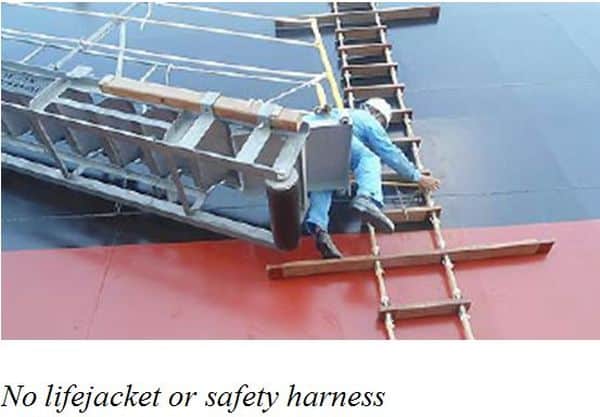
Many serious injuries (or deaths) are caused by falls from gangways or embarkation ladders. Vessel risk assessors frequently see gangways that are badly rigged or otherwise in a poor condition and witness dangerous working practices. Often, accidents occur while the gangway is being rigged. Rigging the stanchions and the side ropes is inherently dangerous as there can be little for crew members to hold on to until this is completed. On the other hand, many ships are now fitted with a gangway safety wire to which the safety harness line can be attached or even fall inertia blocks which allow for greater freedom of movement. Consider how best to rig stanchions and safety chains. In the photo below on the left, it is clearly difficult to step onto the bottom platform from the bow of the launch, while on the right access from a launch to the gangway or vice versa is much easier. Sometimes the bottom platform has not been adjusted to suit the ship’s draught. The bottom platform should be as close to the horizontal as possible to ease access and increase safety. Other common faults with gangways include incorrectly rigged safety nets, slack sidelines, slippery steps and loose or missing stanchions. The gangway safe weight limit (SWL) is often unrealistically large, sometimes as much as one person per step. Although the physical static strength of the gangway and wire could probably bear this number of persons, the dynamic load (bouncing effect) should be considered. Lessons learned Crew should always wear a safety harness and lifejacket while rigging a gangway. Even though installing a safety harness line can sometimes be difficult and movement restricted by the length of the harness line, a life saved is well worth the effort. Gangways should be inspected regularly. Particular attention should be paid to areas where there are aluminium alloy to steel connections. The absence or deterioration of the insulating gasket can lead to electrolytic corrosion, which will cause wastage and hence weakening. Ensure a proper and realistic SWL is indicated on the gangway. Strictly enforce this limit, even when stevedores, agents, inspectors and chandlers want to board ‘en masse’ as soon as they are able. Gangways should never be raised or lowered when personnel are on them. In certain situations, the use of pilot ladders may be the safest, or only, option. However, as their name infers, these are mainly for the use of pilots who are specifically trained in their use. Reference: nautinst.org Disclaimer : The information on this website is for general purposes only. While efforts are made to ensure accuracy, we make no warranties of any kind regarding completeness, reliability, or suitability. Any reliance you place on such information is at your own risk. We are not liable for any loss or damage arising from the use of this website. Related Posts Real Life Incident: Collision Of Container Ship and General Cargo Ship Leads To Sinking And Fatalities Real Life Incident: Collision and Sinking of Small Craft in Shipping Lane Real Life Incident: Crew Saved but Ship Lost Real Life Incident: Pin Holes Create Pathway To Fatal Reckoning Related Posts Real Life Incident: Collision Of Container Ship and General Cargo Ship Leads To Sinking And Fatalities Real Life Incident: Collision and Sinking of Small Craft in Shipping Lane Real Life Incident: Crew Saved but Ship Lost Disclaimer : The information on this website is for general purposes only. While efforts are made t
Unsafe Practices That Lead To Gangway Accidents On Ships
Marine Insight
Read full article at Marine Insight →
Opens Marine Insight in a new tab