news Decarbonization & energy Hellenic Shipping News
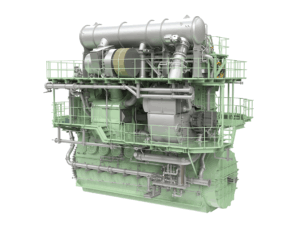
Ammonia technology moves closer to powering deep-sea shipping in International Shipping News,Shipping: Emission Possible 16/02/2026 Ammonia propulsion is moving from concept to commercial reality as several engine developers bring dual‑fuel designs to market. Everllence’s new ME‑LGIA engine integrates advanced safety barriers, digital connectivity, and fuel flexibility, marking a significant step towards practical zero‑carbon deep‑sea shipping. As the maritime industry accelerates towards decarbonization, the transition to low greenhouse gas fuels is essential. Liquefied natural gas and methanol have led the way, but ammonia is making some strides. With three ammonia-capable ships already in operation and another 45 on order, momentum is building. Driving decarbonization with ammonia Ammonia offers compelling advantages. It is carbon-free at the point of combustion and can significantly reduce overall emissions when produced from renewable sources. Its volumetric energy density makes it suitable for deep-sea shipping, where long voyages demand robust fuel solutions. However, adoption is not without hurdles. Ammonia’s high toxicity and corrosive nature require stringent safety measures and specialized handling protocols, far beyond those for conventional fuels. Questions around bunkering infrastructure, crew training, and life-cycle emissions remain critical. Nonetheless, ammonia represents a viable option for the future of shipping if these challenges can be solved. Engine developers commit to ammonia As momentum gathers, engine manufacturers are stepping up to develop propulsion systems suited for ammonia. WinGD and J-ENG delivered their first dual-fuel two-stroke engines in late 2025, followed by Everllence in early 2026, while Hyundai’s HiMSEN H22CDF-LA four-stroke engine has already achieved multiclass approval. Among the vessels on order, seven, including those from shipowners such as Höegh Autoliners and Eastern Pacific Shipping, will feature Everllence’s newly launched two-stroke ammonia engines, rated at 10–15 megawatts. Introducing the ME-LGIA ammonia dual-fuel engine The Everllence ME-LGIA (liquid gas injection ammonia) dual-fuel engine marks a major milestone for zero-carbon propulsion. Based on the diesel principle, the engine employs a liquid gas injection concept, enabling operation on both ammonia and conventional fuels. This flexibility supports shipowners during the transition phase, allowing vessels to switch between fuel types as infrastructure and supply chains mature. Hrishikesh Chatterjee, Senior Promotion Manager – Newbuildings at Everllence, explains: “Our ME-LGIA engine is designed to deliver the same reliability and efficiency as our conventional two-stroke engines, while enabling shipowners to take a decisive step towards zero-carbon operations. Safety and digitalization have been at the core of this development.” Integrated safety barriers and digital connectivity for secure ammonia operations To address ammonia’s unique safety challenges, Everllence has integrated double-walled piping with continuous ventilation and monitored airflow routed to treatment systems. Features such as the ammonia release mitigation system and the ammonia catch system, incorporating a knockout drum and watercolumn scrubbing, help ensure that any leaks are contained and neutralized before they can reach occupied spaces. The fuel valve train, which includes double block and bleed isolation supported by nitrogen purging routines, adds
Ammonia technology moves closer to powering deep-sea shipping
Hellenic Shipping News
Read full article at Hellenic Shipping News →
Opens Hellenic Shipping News in a new tab